Maxwell Taber
One Flew Over the Cuckoo's NestMaxwell Taber’s brief challenge to the ward’s medication routine becomes one of Chief Bromden’s clearest examples of institutional force disguised as treatment. After Taber asks what he is being made to swallow, Nurse Ratched and the ward’s black aides override his refusal; later, Bromden imagines him returned to society as an exemplary, thoroughly adjusted citizen. The contrast between the man dragged from the ward and the man praised by his town gives Taber’s episode its significance: the system calls its work a cure, while Bromden sees a process of remaking.
Identity and First Appearance
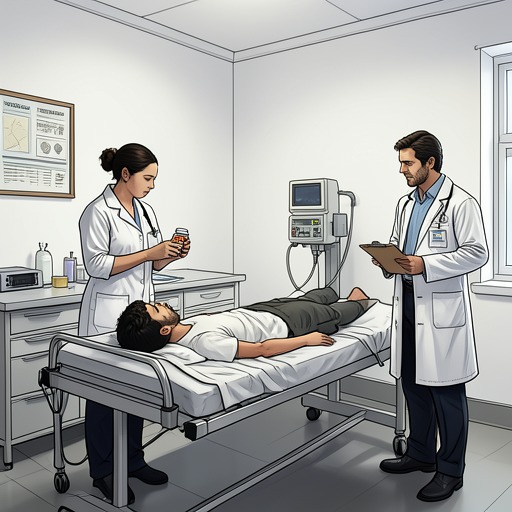
Taber is introduced during the morning medication line as a large Acute who already has a reputation as a troublemaker. The ward’s routine is orderly: patients line up, receive capsules in paper cups, and wash them down with water. Against that practiced sequence, Taber pauses to ask about two small red capsules mixed in with his vitamin. His question is specific and limited; the narration does not describe him as refusing all care or explaining a broader objection. It is enough that he wants to know what he is being required to take.
The staff response immediately changes the meaning of the exchange. A nurse begins to calm him, but Nurse Ratched arrives, grips his arm, and tells the other nurse that if Taber chooses to act like a child he may have to be treated as one. She frames the staff’s earlier kindness and consideration as having failed, then calls his response hostility. Taber is told that he may leave if he will not take the medication orally. The language presents a choice, but the action and the surrounding authority make clear how little room there is for an independent question.
Refusal and Forced Treatment
The ward’s black aides catch Taber in the latrine and drag him to the mattress room. He kicks one of them in the shins and yells, but Bromden is struck by how helpless he looks once they hold him, as if bound in bands of black iron. The description moves from an ordinary dispute over capsules to physical domination: the aides pin him face down, one sits on his head, and the other tears open the back of his pants. Taber curses into the mattress while the aide restraining him speaks to him in a soothing, almost taunting tone.
A nurse arrives with a long needle smeared with Vaseline and shuts the door, briefly removing the procedure from view. She emerges wiping the needle on a shred of Taber’s pants, leaving the jar behind. Bromden catches another small detail before the door closes: an aide is dabbing Taber with a Kleenex. The aides remain in the room for a long time, then carry him across to the lab with his greens ripped away and a damp sheet wrapped around him. These details make the coercion bodily and specific; the episode is not merely an argument about compliance but a procedure imposed on a restrained patient.
Taber is later wheeled out of the lab on a gurney. A technician tells Nurse Ratched that he had to be given another shot when he began coming around during a spinal tap. The technician suggests taking him for EST as well, so the extra Seconal will not be wasted, and proposes an electroencephalograph examination that might reveal a need for brain work. Nurse Ratched approves the suggestion. The sequence extends the original punishment beyond the medication line: Taber’s question is followed by sedation, invasive examination, and discussion of additional treatment, all conducted as routine clinical decisions.
The Returned Citizen
Bromden’s account then widens from the lab to a vision of what happens after Taber leaves the hospital. He describes the ward as a factory belonging to The Combine, where people who arrive twisted or different are repaired into functioning components and sent back into society. In this imagined future, an approving observer points to Maxwell Taber’s change since the hospital: he is a little bruised around the eyes, has lost weight, and is called a new man. The praise turns visible signs of treatment into evidence of successful modernization.
The vision darkens as Bromden describes Taber’s supposed life after his return. Technicians have installed what he calls Delayed Reaction Elements, which lend nimble skill to Taber’s fingers. Late at night, Taber bends over the doped figures of his wife, his two young daughters, and the neighbor he bowls with, adjusting them as he himself was adjusted. This is not presented as an independently verified account of Taber’s later conduct; it belongs to Bromden’s larger, disturbing picture of the ward’s influence spreading outward through the people it sends home. The family and neighbor make that imagined spread intimate: adjustment does not end with the patient but reaches into the relationships around him.
Bromden carries the projection through to its polished civic ending. After a preset number of years, Taber runs down; nevertheless, the town loves him, a newspaper prints his picture helping the Boy Scouts on Graveyard Cleaning Day, and his wife receives a letter from the high-school principal praising him as an inspiration to young people. The public honors erase the violence Bromden has just described. In the town’s account, Taber is a model citizen; in the narrator’s account, that acceptable figure is the product of a system that has first imposed its own adjustments on him.
Narrative Role and Significance
Taber’s episode is brief, but its structure connects everyday ward procedure to Bromden’s broad critique of social conformity. It begins with the material fact of two red capsules and a patient asking what they are, then proceeds through restraint, an injection, and proposed examinations. From there, the narration leaps into an imagined future in which the patient has become a praised component of the community. The shift makes the contrast itself an argument: what the institution and town call improvement may, in Bromden’s vision, be the successful production of obedience.
Bromden’s factory language also complicates the apparent boundary between hospital and society. The ward does not simply contain patients until they recover; in his account, it repairs people to fit the neighborhoods, schools, and churches to which they return. Taber’s imagined transformation therefore serves as a miniature of the larger system. His original question registers a moment of personal scrutiny, while his later public image represents the disappearance of that challenge beneath the reassuring label of a new man.